
Dimapur (Hidimbapur)
Updated 2026Medieval Kachari Megalithic Capital & Multimodal Gateway to the Naga Hills
| Category | Detail |
|---|---|
| Altitude / Elevation | 195 meters (640 ft) |
| Best Time to Visit | October to April (Mild, pleasant winter weather with low humidity) |
| Coordinates | 25.9068° N, 93.7275° E |
| Distance To Kohima | 74 km southeast along 4-lane NH29 (2.5 to 3.5 hours) |
| District | Dimapur District / Chumoukedima District, Nagaland |
| Historical Identity | Medieval Capital of the Dimasa Kachari Kingdom (10th–16th Century A.D.) |
| Major Highways | National Highway 29 (Asian Highway 1/2) & National Highway 129 |
| Nearest Airport | Dimapur Airport (DMU) — In-city (7 km from center) |
| Nearest Railhead | Dimapur Railway Station (DMV) — Central Lumding–Dibrugarh Line |
| Permit Requirement | Inner Line Permit (ILP) mandatory for domestic Indian visitors (Extended to Dimapur in Dec 2019) |
| Population | approx. 230,000 (Metropolitan Urban Area) |
Dimapur is the largest city, primary commercial metropolis, and sole multi-modal transportation gateway of Nagaland, situated at an altitude of 195 meters (640 feet) on the fertile alluvial plains of the Dhansiri River. Historically celebrated as the 10th-to-13th-century capital of the Dimasa Kachari Kingdom—evidenced by the monumental carved sandstone monoliths of Rajbari Park—the city serves as the state’s sole commercial aviation hub (Dimapur Airport DMU) and primary broad-gauge railway junction (DMV), linking the plains of Assam directly to Chumoukedima, Diezephe Craft Village, and the mountain highway ascending to Kohima.
The tropical morning warmth rises from the banks of the Dhansiri River, carrying the scent of damp bamboo shoots, roasted king chillies, and fresh river herbs from bustling street markets. Amid the shaded lawns of Rajbari, towering tenth-century mushroom-domed stone monoliths stand silent and ancient, etched with intricate geometric spirals and animal reliefs that whisper of medieval Kachari royalty before the rugged mountain wall of the Naga Hills.
Inner Line Permit (ILP) is legally mandatory for all domestic Indian citizens entering Dimapur District. Effective December 2019, the Government of Nagaland extended the Bengal Eastern Frontier Regulation (BEFR) 1873 ILP regime across the entire district of Dimapur. Indian travelers must apply online at ilp.nagaland.gov.in (₹200 per person for 30-day tourist ILP, ₹500 for foreign tourists) prior to boarding flights or trains into Dimapur. Foreign nationals do not require an ILP or central PAP under relaxed MHA norms, but must complete mandatory registration with the Foreigners Registration Officer (FRO) / SP Office within 24 hours of arrival (excluding citizens of Pakistan, China, and Afghanistan who require prior MHA clearance).
Alluvial Plain Topography & Gateway Geography (195 m)
Dimapur is situated on the broad, fertile alluvial floodplains of the Dhansiri River in southwestern Nagaland, resting at an average elevation of 195 meters (640 feet) above sea level. Located at geographical coordinates 25.9068° N, 93.7275° E, the city occupies a vital strategic lowland corridor directly bordering Karbi Anglong and Golaghat districts of Assam. While the rest of Nagaland is defined by precipitous mountain ridges, Dimapur's topography is gentle and riverine, framed to the south and east by the abrupt, forested mountain wall of the Barail Range.
The name Dimapur originates from the indigenous Dimasa Kachari language: Di (meaning river or water), Ma (meaning great or big), and Pur (meaning city or settlement)—translating to 'The City of the Great River' (Dhansiri). Due to its low elevation, Dimapur experiences a sub-tropical valley climate distinctly different from the temperate Naga Hills. Autumn and winter (October to April) bring dry, sunny days and cool, refreshing evenings with temperatures ranging between 10°C and 24°C, creating ideal conditions for exploring archaeological parks and craft centers. The southwest monsoon (June to September) brings substantial rainfall (approx. 1,500 mm to 1,800 mm), replenishing local river ecosystems and surrounding agricultural wetlands.
The Medieval Kachari Kingdom & Megalithic Rajbari Ruins
Dimapur is an archaeological treasure trove, serving from the 10th to the early 16th century A.D. as the fortified royal capital of the Dimasa Kachari Kingdom (Hidimbapur), one of the most sophisticated indigenous river valley civilizations of pre-colonial Northeast India. The kingdom reached its zenith of architectural and metallurgical achievement before being sacked following historic military campaigns by the Ahom King Suhungmung (Dihingia Raja) in 1536 A.D., which forced the Kachari royals to migrate south to Maibang and Khaspur.
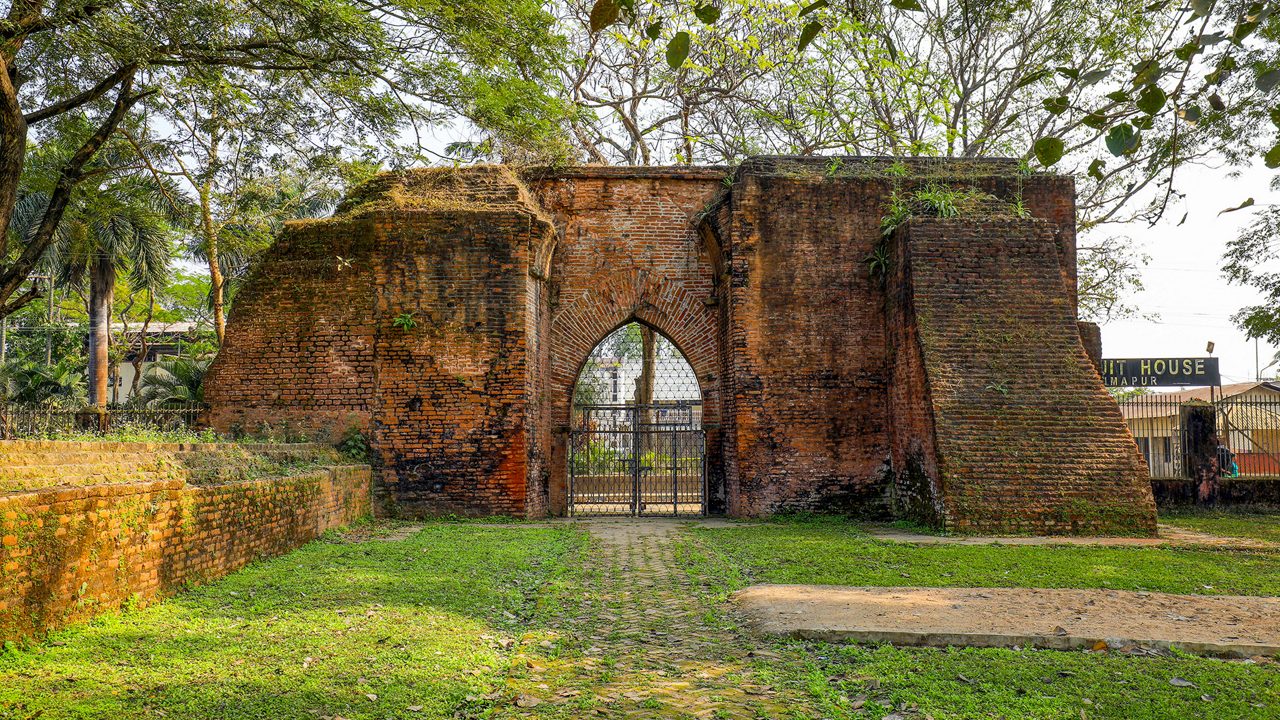
The physical testament to this medieval kingdom survives at Rajbari Park (The Kachari Ruins) in the heart of Dimapur. Excavated and protected by the Archaeological Survey of India (ASI), this ancient royal citadel is world-famous for its extraordinary collection of megalithic carved sandstone monoliths:
- Mushroom-Domed Monoliths (Lingam Pillars): Towering mushroom-shaped sandstone pillars standing up to 15 to 17 feet in height. Carved with remarkable precision from solid river boulders, these monoliths feature rounded bulbous capitals that served as phallic lingam fertility symbols and markers of royal lineage.
- V-Shaped & Horned Pillars (Yoni & Warrior Symbols): Massive bifurcated V-shaped stone monoliths engraved with intricate bas-relief carvings of sacred animal motifs—including elephants, peacocks, deer, and river fish—alongside geometric rosettes, floral bands, and ancient Dimasa warrior crests.
- Medieval Moats & Gateway Bastions: The perimeter of the Rajbari complex retains traces of medieval brick embankments, fortified earthen moats, and ancient royal water storage reservoirs (Pukhuri), demonstrating the advanced water harvesting and defensive military engineering of the Kachari rulers.
Multimodal Transportation Backbone: Railhead, Airport (DMU) & Asian Highway 1
As the undisputed transportation hub of Nagaland, Dimapur provides the sole multimodal artery connecting the remote interior hill districts to the rest of India:
- Dimapur Airport (DMU): Located in 3rd Mile, just 7 km from the central market, Dimapur Airport is the only operational commercial airport in Nagaland. The airport operates scheduled daily non-stop flights connecting the state to Kolkata Netaji Subhash Chandra Bose International Airport (CCU) and Guwahati Lokpriya Gopinath Bordoloi International Airport (GAU), with single-stop connections from New Delhi, Mumbai, and Bengaluru operated by IndiGo and Alliance Air.
- Dimapur Railway Station (DMV): Situated on the strategic Lumding–Dibrugarh broad-gauge mainline of the Northeast Frontier Railway, DMV is Nagaland's primary passenger and freight rail junction. The station receives premier superfast nationwide services including the Dibrugarh Rajdhani Express, Kamrup Express, Brahmaputra Mail, and the daily Guwahati–Jorhat Jan Shatabdi Express.
- National Highway 29 (NH29 Corridor): Dimapur is the western terminus of the four-lane National Highway 29 (Asian Highway 1/2). The highway crosses the Chumoukedima foothill gate and ascends the Barail Range, connecting Dimapur to Kohima (74 km, 2.5–3.5 hours) and onward to the international border with Myanmar via Imphal and Moreh.
Indigenous Handicraft Mastery: Diezephe Craft Village & Living Handlooms
Located 13 km south of central Dimapur, the village of Diezephe is celebrated as the premier artisan epicenter for traditional Naga material crafts. Managed under the aegis of the Nagaland Handloom and Handicrafts Development Corporation (NHHDC), Diezephe is an authentic community village where master artisans specialize in ancestral woodcarving, cane and bamboo craft, and indigenous backstrap loom weaving.
Key handicraft traditions practiced in Diezephe include:
- Ancestral Woodcarving: Master craftsmen sculpt massive single logs of local teak, gamari, and jackfruit wood into traditional Naga Morung architectural pillars, Mithun head wall sculptures, decorative wooden bowls, and miniature log drums.
- Cane & Bamboo Artistry: Intricately woven bamboo storage baskets (Khophi), traditional rain shields, bamboo lamps, and fine cane mats crafted with extraordinary tensile strength.
- Traditional Backstrap Weaving: Local women artisans operate indigenous backstrap looms inside village courtyards, producing exquisite traditional tribal shawls, wrap-around skirts (Mekhala), and table runners using naturally dyed yarns. Visitors can interact directly with master artisans, observe live demonstration workshops, and purchase authentic crafts directly from community cooperatives.
Foothill Gateways: Chumoukedima, Triple Falls & Regional Trade Hubs
Stretching along the southern approaches of Dimapur where the alluvial plains meet the Barail foothills lies Chumoukedima (designated as a separate district headquarters in 2021). Chumoukedima holds deep historical significance as the original 19th-century administrative headquarters established by the British colonial administration in the Naga Hills before the capital was shifted uphill to Kohima in 1879.
Highlights of the Chumoukedima foothill corridor include:
- The Chumoukedima ILP Check Gate: The official entry inspection gateway along NH29 where Nagaland Police and IRBn personnel verify physical Inner Line Permits and identity documents for all inbound travelers.
- Seithekima Triple Falls: A scenic natural waterfall located in Seithekima village, 16 km from Dimapur. The waterfall cascades in three distinct tiers down vertical volcanic cliffs into a natural forest pool, serving as a popular picnic and nature-walk escape.
- Nagaland Zoological Park: Spanning 176 hectares of protected wetland and deciduous forest in Rangapahar, the zoological park is dedicated to the conservation of endangered Eastern Himalayan fauna, including the Hoolock Gibbon (Hoolock hoolock) (India’s only ape species), the Great Indian Hornbill, Himalayan Black Bear, and Clouded Leopard.
Urban Markets, Hong Kong Bazaar & Commercial Crossings
Dimapur functions as the primary wholesale and retail trading hub of Nagaland, characterized by vibrant multi-ethnic bazaars:
- Hong Kong Market: Situated near the railway station along Central Road, Hong Kong Market is a legendary, bustling commercial bazaar renowned across Northeast India. The market specializes in imported fashion apparel, electronics, footwear, leather jackets, and accessories sourced through Southeast Asian trade routes, alongside local tribal textiles and bead jewelry.
- New Market & Daily Produce Bazaar: The agricultural heartbeat of the city, where local tribal vendors from surrounding rural villages assemble daily to sell fresh forest produce—including fresh and dried Naga King Chilli (Raja Mircha), fermented bamboo shoot pastes (bastenga), wild mountain ginger, fresh river fish, medicinal forest herbs, and organic local pork.
Dimasa & Naga Tribal Culinary Heritage
The food culture of Dimapur reflects its unique position as a cross-cultural crossroads where ancestral Dimasa Kachari traditions meet the distinctive woodfire culinary heritage of diverse Naga tribes (Angami, Sumi, Lotha, and Ao):
- Smoked Pork with Axone (Akhuni): Cured wood-smoked pork braised with fermented soybean paste (axone), fresh tomatoes, and fiery king chillies, served alongside steaming local white rice.
- Bastenga Broth with Country Chicken: Shredded fermented bamboo shoots braised with country chicken or fresh Dhansiri river fish, creating a refreshing, tangy, and invigorating clear broth.
- Dimasa River Fish Delicacies: Fresh river fish wrapped in fragrant turmeric leaves or banana leaves, stuffed with crushed ginger, garlic, and green chillies, and slow-roasted over open hardwood embers.
- Spicy Chutneys & Boiled Greens: Steamed indigenous squash, wild fiddlehead ferns (dhekia), and roasted tree tomato (tamarillo) chutneys blended with charred king chillies and fermented dry fish.
Practical Travel Intelligence: The 2019 ILP Extension, Transit Seasons & Safety
- Mandatory 2019 ILP Extension: Domestic travelers must note that while Dimapur was historically exempt from the Inner Line Permit system, the Government of Nagaland officially extended the ILP regime to cover the entire Dimapur district in December 2019. All non-resident Indian citizens must secure an approved e-ILP online via
ilp.nagaland.gov.inprior to traveling by flight or train. - Optimal Transit Seasons: Dimapur is best explored between October and April, when temperatures are pleasant (10°C–24°C). Summer months (May–August) can be hot and humid (32°C–35°C), while monsoon rains can cause localized waterlogging in lower market areas.
- Transit Staging to Kohima: Shared Tata Sumos depart continuously from the Dimapur Sumo Stand outside the railway station to Kohima (₹350–₹450 per seat, 2.5–3.5 hours). Private pre-paid taxis and rental SUVs (₹2,500–₹3,500) are available at the airport and station terminals for direct hotel transfers to Kohima, Kigwema, or Khonoma.
Dimapur is part of the breathtaking Northeast India region, known for its pristine natural beauty, rich tribal culture, and unique biodiversity.
TRAVEL PLANNING
Plan Your Visit
Essential guides to prepare for your trip
Itineraries & Trips
Curated 3-day, 5-day & 7-day trip routes
Places to Visit
Top waterfalls, viewpoints & landmarks
Best Time to Visit
When to go for the best experience
How to Reach
Flights, trains, taxis and road options
Where to Stay
Homestays, eco-lodges & resorts
Permits & Entry
Required documents and ILP pass guidance
Dimapur Tour Packages
Ready-to-book Dimapur tours

Need a Custom Plan?
As Northeast India locals, we work directly with our trusted community drivers and homestay hosts.
Talk to an ExpertTOP ATTRACTIONS
Places to Visit in Dimapur
Must-see attractions and hidden gems across Dimapur
How Many Days in Dimapur?
Plan your own route — or let us handle everything
Things to Do in Dimapur
Curated experiences and activities across Dimapur by local experts
Where to Stay in Dimapur
Verified stays in Dimapur with local character


Getting Around
Safe, reliable transfers and car hire in Dimapur
Practical Travel Realities & Local Tips
Terrain, ground rules, and essential preparation for Dimapur
Dimapur is an Easy lowland destination situated at an altitude of 145 meters. All primary attractions including Kachari Rajbari Ruins, Diezephe Craft Village, and Nagaland Zoological Park feature flat terrain accessible by vehicle with minimal walking.
Local Culinary Traditions & Food
Authentic indigenous gastronomy, tribal flavours, and culinary culture in Dimapur
Dimapur's culinary scene bridges traditional Dimasa ethnic food with diverse Naga tribal specialties. Must-try dishes include Smoked Pork with Axone (fermented soya bean), Pork with Bastanga (fermented bamboo shoot), fresh Dhansiri river fish in banana leaves, and spicy Raja Mircha chutneys served with steamed rice.
Combine Dimapur With
Extend your trip with nearby destinations
Travel Guides
Expert guides for Dimapur
Reviews
"Nezo Tours organized our fantastic trip. The team was attentive and flexible, accommodating last-minute changes to suit our needs."
Yamini Peter
Mumbai, Maharashtra
"We got the best service than expected. The guide was very friendly and very very helpful, throughout our journey he guided us."
Ammiel Shabong
Shillong, Meghalaya
"Service was excellent. Prices were the best compared to those offered by others. All in all a satisfying experience. Definitely recommended."
Pradeep Agarwal
Delhi, India
PLAN YOUR TRIP
FAQs
Can't find the answer you're looking for? Our expert travel team is always on hand to help you plan the perfect Dimapur experience.
Ready to Explore Dimapur?
Let our local experts help you plan the perfect trip. Get personalized recommendations and instant quotes.