
Dzukou Valley (Dzüko Valley)
Updated 2026High-Altitude Alpine Caldera of Dwarf Bamboo & Endemic Wild Lilies
| Category | Detail |
|---|---|
| Altitude / Elevation | 2,452 meters (8,045 ft) |
| Average Trek Duration | 3.5 to 5 hours one way to SAYO Rest House |
| Coordinates | 25.5539° N, 94.0754° E |
| Endemic Species | Dzukou Lily (Lilium chitrangadae), Blyth's Tragopan, Giant Himalayan Rhododendron |
| Location | Barail Range, Nagaland–Manipur Interstate Border (Kohima District) |
| Management | Southern Angami Youth Organisation (SAYO) Community Conservation Council |
| Night Temperatures | -2°C to -6°C in Winter (Dec–Feb); 10°C to 14°C in Summer (Jun–Aug) |
| Permits | Nagaland Inner Line Permit (ILP: ₹200) + SAYO Entry Registration (₹100 Indian / ₹500 Foreigner) |
| Primary Ecosystem | High-Altitude Dwarf Bamboo Meadows & Temperate Cloud Rainforest |
| Trekking Distance | Viswema Route: 8 km 4x4 road + 1.5 km stone staircase + 5.5 km ridge walk; Jakhama Route: 4.5 km steep direct gorge climb |
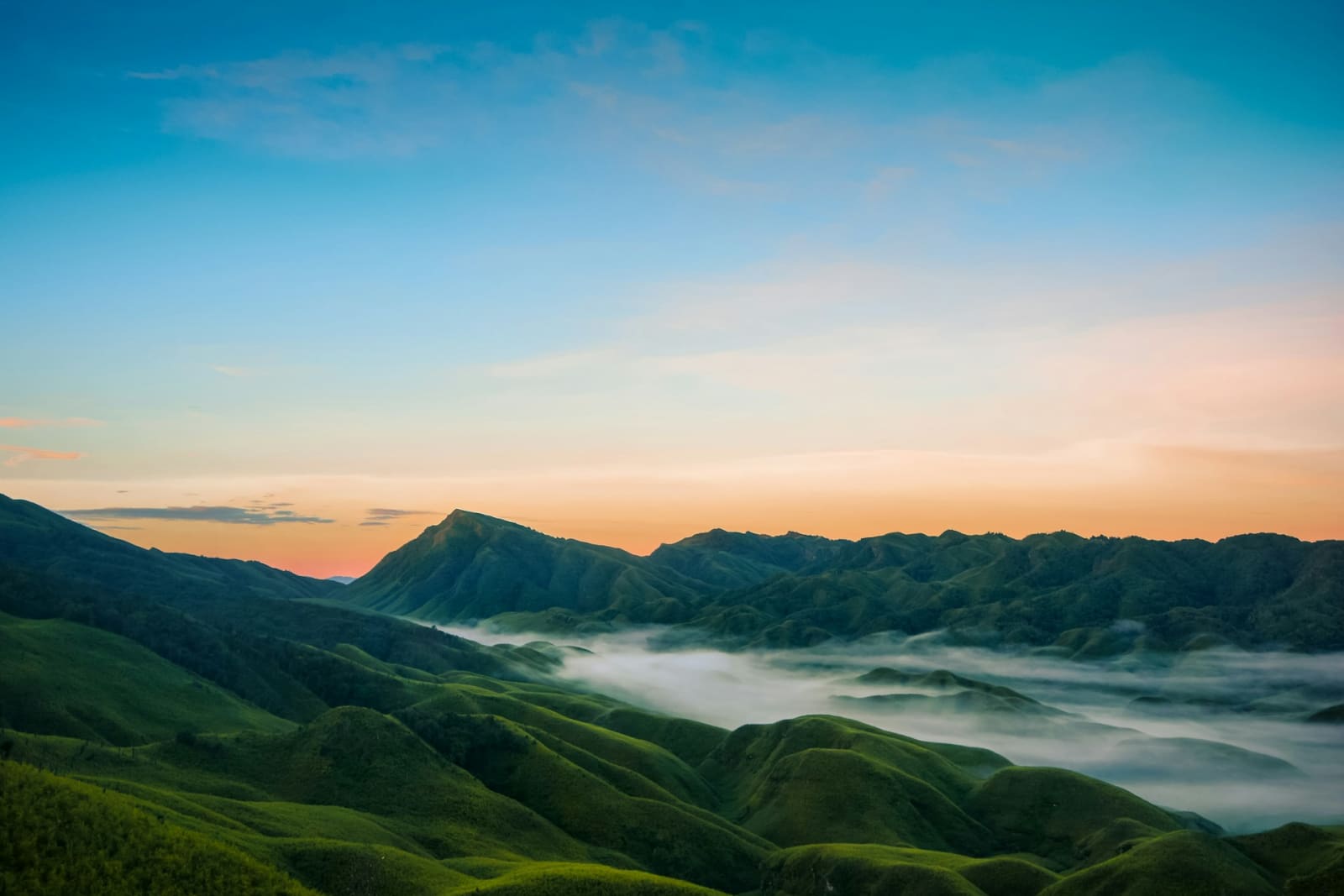
Dzukou Valley is a pristine high-altitude alpine caldera basin situated at an elevation of 2,452 meters (8,045 feet) along the crest of the Barail Range, straddling the border of Nagaland (Kohima District) and Manipur (Senapati District). Celebrated for its unique topography of undulating emerald dwarf-bamboo (Yushania alpina) meadows, serpentine cold streams that freeze solid in winter, and the endemic pink Dzukou Lily (Lilium chitrangadae), the valley represents one of the most magnificent, untouched wilderness trekking sanctuaries in the Eastern Himalayas.
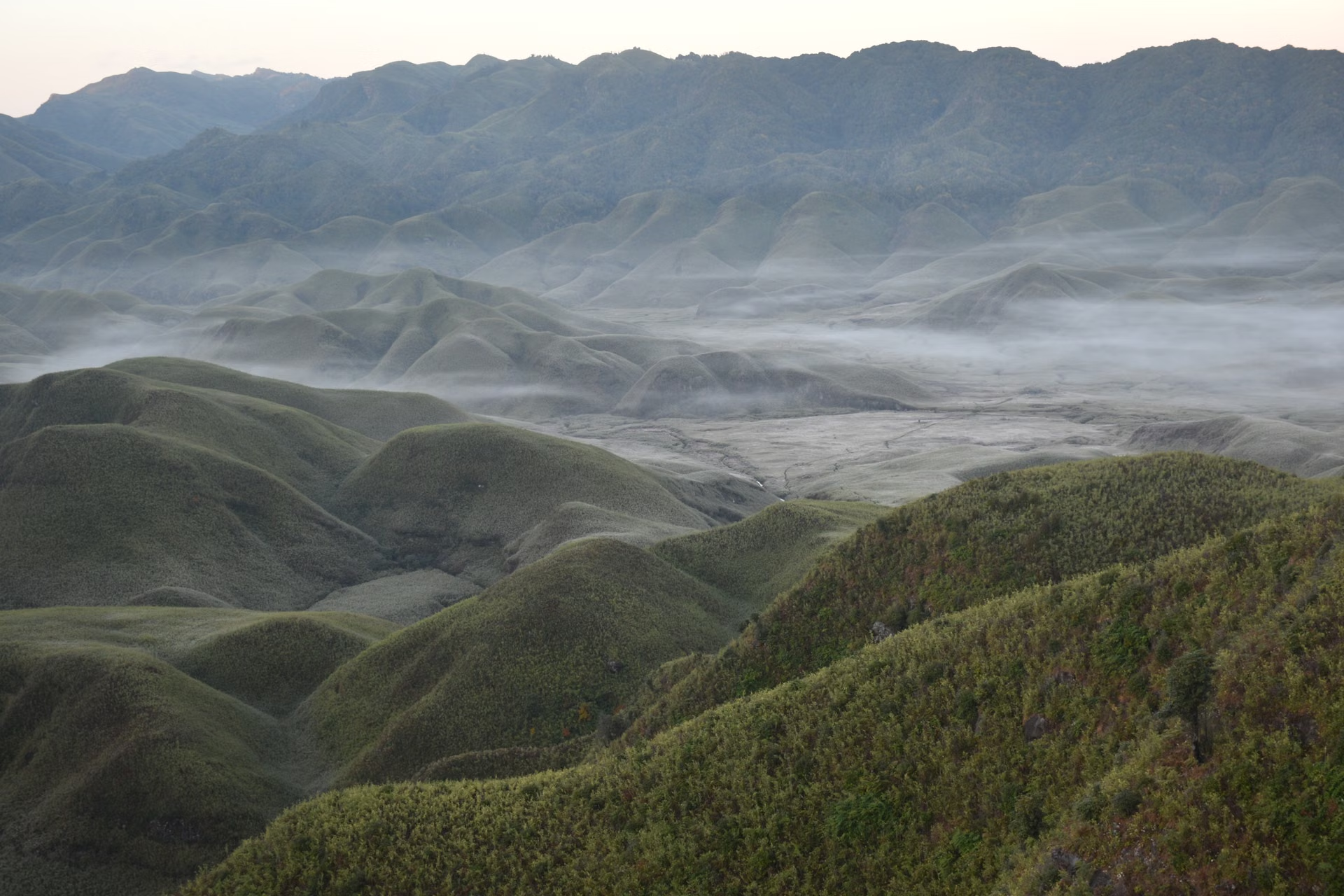
A crisp, thin mountain wind whispers across vast, rolling hummocks of emerald dwarf bamboo standing beneath high granite cliffs. Crystal-clear cold rivulets glide silently over polished river stone and white sandy banks, while morning hoarfrost sparkles like crushed diamond dust across the petals of rare pink lilies in the high silence of the Barail rim.
Domestic Indian travelers must hold a valid Nagaland Inner Line Permit (ILP) obtained online at ilp.nagaland.gov.in (₹200 per person for 30 days validity, ₹500 for foreign tourists) prior to entering Kohima District. In addition, all visitors must register at the Southern Angami Youth Organisation (SAYO) checkpoint at the Viswema or Jakhama trailhead and pay standard community entry fees (₹100 for Indian citizens, ₹500 for foreign nationals, ₹50 for students). General foreign nationals are exempt from PAP under relaxed MHA guidelines, requiring only routine FRO registration in Kohima within 24 hours of arrival (excluding citizens of Pakistan, China, and Afghanistan). A refundable plastic security deposit of ₹50–₹100 is collected at the trailhead to enforce strict zero-litter regulations.
Topography, High-Altitude Caldera & Geological Formation (2,452 m)
Dzukou Valley is an extraordinarily rare high-altitude alpine caldera basin nestled at an average altitude of 2,452 meters (8,045 feet) in the heart of the Barail mountain range. Located at 25.5539° N, 94.0754° E, the valley occupies a high natural depression along the watershed boundary separating the state of Nagaland (Kohima District) to the north from Manipur (Senapati District) to the south. Flanked on its eastern rim by the towering mass of Mount Japfü (3,048 m) and bordered by sheer, rugged granite precipices, the floor of Dzukou forms a vast, gently rolling amphitheater of rounded hills and hollows that resembles an emerald sea of rolling green waves.
Geologically, the valley basin represents an ancient, uplifted paleolake bed formed during the tertiary orogeny of the Eastern Himalayan and Indo-Burman ranges. Over millennia, continuous glacial scouring, seismic faulting, and intense water drainage carved deep, labyrinthine subterranean drainage channels beneath the rock strata. The floor of the valley is carpeted almost exclusively by dense, uniform thickets of dwarf bamboo (Yushania alpina / Arundinaria callosa), which grow to a uniform height of only 0.5 to 1.2 meters, giving the landscape its iconic, velvet-green upholstered appearance. This dwarf bamboo ecosystem is uniquely adapted to survive extreme winter frosts, high wind shear along the ridgelines, and seasonal waterlogging.
Endemic Flora, The Dzukou Lily (Lilium chitrangadae) & Dwarf Bamboo Biome
Dzukou Valley is revered across the international botanical community as a unique high-altitude biodiversity hotspot harboring remarkable endemic and rare floral species. The undisputed crowning jewel of the valley's botanical treasure is the Dzukou Lily (Lilium chitrangadae), a rare, wild pink lily found nowhere else on Earth. Discovered and scientifically documented by the Botanical Survey of India in the early 1990s, the Dzukou Lily features delicate, bell-shaped, pale-pink to deep-rose petals adorned with tiny purple speckles at the throat. The lilies burst into peak flowering between mid-June and late July, carpeting the misty dwarf-bamboo hillocks by the millions.
Beyond the iconic lily, the valley's complex microclimate supports a rich succession of montane wildflowers throughout spring and summer:
- Summer Wildflowers (June–August): Extensive colonies of wild pink and white anemones (Anemone rivularis), cobalt-blue aconitum, yellow and purple marsh orchids (Gymnadenia orchidis), wild potentillas, and flowering euphorbias.
- Spring Forest Blooms (March–May): The dense cloud rainforests lining the outer rim of the caldera erupt in brilliant blooms of giant rhododendrons—including Rhododendron arboreum (blood red), Rhododendron falconeri (creamy yellow), and Rhododendron grande (pure white)—mingled with wild epiphytic orchids, mountain magnolias, and giant tree ferns.
- Faunal Sanctuaries: The dense forest canopy surrounding the valley provides a sanctuary for endangered highland wildlife, including the elusive Blyth’s Tragopan (Tragopan blythii), the Himalayan Serow (Capricornis sumatraensis), Asiatic Black Bear, leopard cats, and rare high-altitude laughingthrushes.
Serpentine Hydrology, Crystal Streams & Sub-Zero Winter Ice Formations
The hydrological system of Dzukou Valley is defined by two primary crystalline mountain streams—the Dzukou River and the Japfu River—which meander silently across the flat basin floor before merging and plunging westward through precipitous gorges into the Barak River drainage basin. Because the riverbeds are carved through solid, polished basaltic granite and clean white quartz sand, the waters are remarkably transparent, pure, and ice-cold year-round.
During winter (December to February), the hydrology of Dzukou undergoes an extraordinary physical transformation:
- Sub-Zero Freezes: Nighttime temperatures across the valley regularly plummet to between -2°C and -6°C.
- Frozen Rivulets & Needle Ice: The tranquil meandering river channels, shallow pools, and waterfalls freeze into solid, glassy sheets of crystal ice. Along the riverbanks, soil moisture expands into vertical columns of delicate 'needle ice' (kammeis) that elevate pebbles and moss patches above the ground.
- Silver Hoarfrost Dawns: Every morning before sunrise, thick blankets of crystalline silver hoarfrost coat every blade of dwarf bamboo and every rock surface across the basin. As the first rays of morning sunlight crest the Barail ridge, the frost catches the light, illuminating the entire amphitheater in dazzling diamond-like radiance before melting away into morning mist.
The Two Ascent Arteries: Viswema Ridge vs. Jakhama Gorge Trail
Because Dzukou Valley is a protected, roadless alpine sanctuary, reaching its rim requires foot trekking from one of two designated staging villages located along National Highway 2 south of Kohima:
1. The Viswema Trail (Recommended for Ascent)
- Trailhead Location: Viswema Village, 25 km south of Kohima along NH2.
- The Approach: From the highway gate, an 8 km unpaved gravel road climbs 600 vertical meters through pine and alder forest to Trekkers Point. This stretch is negotiable by 4x4 Mahindra Bolero pickups (approx. 40 minutes, saving 2.5 hours of tedious road walking).
- The Staircase Climb: From Trekkers Point, the trail begins as a steep, unrelenting stone staircase ascending through dense, moss-draped temperate cloud forest. Over a distance of 1.5 km, hikers ascend over 400 vertical meters (approx. 1,200 hand-laid stone steps) in 45 to 60 minutes to reach the ridge crest.
- The Ridge Walk: Upon topping the ridge, the physical strain ends abruptly. The trail transitions into a breathtaking, gentle 5.5 km contour walk (approx. 2 hours) that winds along the outer rim through rolling dwarf bamboo meadows directly to the SAYO Trekkers Rest House.
2. The Jakhama Trail (Recommended for Descent)
- Trailhead Location: Jakhama Village, 18 km south of Kohima along NH2.
- The Trail Profile: From the Jakhama farm road, the path follows the course of a roaring mountain torrent directly up a steep canyon gorge. Over a distance of 4.5 km, the trail consists of a continuous, grueling stone staircase cut into the mountain slope.
- Ascent vs. Descent: Ascending via Jakhama requires 3.5 to 4.5 hours of strenuous cardiovascular effort with zero flat relief. However, as a descent route, Jakhama allows hikers to drop rapidly from the rest house back down to the highway in 2.0 to 2.5 hours, making the combination of 'Ascend via Viswema, Descend via Jakhama' the classic, optimal circuit.
Southern Angami Stewardship: SAYO Regulations & The Trekkers Rest House
Dzukou Valley is ancestral property stewarded under customary Naga tribal law by the Southern Angami Youth Organisation (SAYO), representing the indigenous villages of Viswema, Jakhama, Kigwema, and Phesama. SAYO enforces rigorous community conservation bylaws to preserve the fragile alpine ecosystem from commercial exploitation and deforestation.
The SAYO Trekkers Rest House
Perched strategically upon a high panoramic ridge overlooking the southern basin floor, the SAYO Rest House serves as the sole accommodation base inside the valley:
- Dormitory Halls: Two large wooden-floored dormitory halls capable of accommodating up to 100 trekkers (tariff: ₹100 per person per night). Trekkers sleep on the wooden floor using rented foam mattresses (₹50/night) and thick woolen blankets (₹100/night).
- VIP Rooms: Two basic private wooden rooms with attached Indian-style bathrooms (tariff: ₹800 – ₹1,200 per room per night), subject to prior reservation.
- Camping Grounds: Expansive, well-drained outdoor grounds for pitching private alpine tents (pitching fee: ₹200 per tent per night).
- Communal Woodfire Hearth (Mezhü): The thermal and social hub of the rest house, where local Angami caretakers tend an open log fire day and night to boil spring water, prepare hot tea, and cook simple meals for weary hikers.
Hearthside Wilderness Sustenance & Camp Nutrition
All provisions inside Dzukou Valley must be portered uphill on human backs across thousands of steep stone steps. Consequently, food at the rest house is simple, wholesome, and carbohydrate-dense:
- Rest House Meals: Caretakers prepare hearty plates of steaming local white rice, yellow lentil dal, and boiled mountain cabbage served with fiery Naga king chilli paste (approx. ₹200–₹250 per meal).
- Trail Comforts: Hot bowls of instant Maggi noodles cooked with chopped cabbage and eggs (₹70–₹90), steaming cups of sweet black tea, lemon tea, and coffee (₹30–₹40).
- Self-Supported Cooking: Trekkers carrying portable butane stoves and lightweight camp cookware can prepare dehydrated backpacking meals, oatmeal porridge, and soups.
- Water Source & Purification: High-altitude springs feeding the rest house and river rivulets are remarkably clean; however, drinking water should always be boiled over the hearth or filtered through a portable hollow-fiber membrane filter (Sawyer/LifeStraw) or treated with chlorine dioxide tablets before consumption.
Essential Expedition Preparation: Physical Stamina, Cold Defense & Zero-Plastic Ethics
A safe and rewarding expedition into Dzukou Valley requires thorough logistical and physical readiness:
- Zero-Plastic Strict Enforcement: SAYO strictly prohibits single-use plastic carrier bags, non-reusable plastic bottles, and styrofoam. A mandatory ₹50–₹100 refundable plastic security deposit is logged at the trailhead entry counter. Every wrapper, foil, and plastic item brought into the valley must be packed out in personal garbage bags and presented at the exit gate for inspection.
- Cold Weather Defense (Sub-Zero Gear): Between November and March, a certified sub-zero sleeping bag (-5°C comfort rating) is indispensable. Trekkers must pack synthetic/Merino wool thermal base layers, a 200gsm fleece mid-layer, a high-loft down jacket, fleece-lined beanies, and windproof gloves.
- Footwear & Trekking Poles: High-ankle waterproof hiking boots with deep Vibram rubber lugs are critical for preventing twisted ankles and maintaining traction on wet, algae-covered stone stairs. Trekking poles absorb over 25% of knee shock during the steep descents.
- Lighting & Power: There is zero electricity in Dzukou Valley. Bring a high-power LED headlamp (300+ lumens) with spare batteries and a 20,000+ mAh power bank. Keep electronic devices inside your sleeping bag at night to protect lithium batteries from cold-drainage.
Practical Travel Intelligence: Inner Line Permits, Staging Logistics & Emergency Preparedness
- Statutory Inner Line Permit (ILP): Domestic Indian visitors must obtain an approved e-ILP online via
ilp.nagaland.gov.inprior to arrival. Physical printed copies must be shown at the Chumoukedima checkpost along NH29. - Foreign Registration (FRO): Foreign passport holders must complete routine registration at the Kohima Police SP Office / FRO within 24 hours of arrival in the district.
- Complete Cellular Blackout: Mobile phone networks (Jio, Airtel, Vi, BSNL) lose reception completely once crossing the Barail ridge. Download offline GPS maps (Gaia GPS, Google Maps Offline) before departing Kohima.
- Cash Economy: All transactions at the trailheads, SAYO counters, 4x4 Bolero pickups, porters, and rest house hearth operate strictly on physical Indian Rupee cash.
Dzukou Valley is part of the breathtaking Northeast India region, known for its pristine natural beauty, rich tribal culture, and unique biodiversity.
TRAVEL PLANNING
Plan Your Visit
Essential guides to prepare for your trip
Itineraries & Trips
Curated 3-day, 5-day & 7-day trip routes
Places to Visit
Top waterfalls, viewpoints & landmarks
Best Time to Visit
When to go for the best experience
How to Reach
Flights, trains, taxis and road options
Where to Stay
Homestays, eco-lodges & resorts
Permits & Entry
Required documents and ILP pass guidance
Dzukou Valley Tour Packages
Ready-to-book Dzukou Valley tours

Need a Custom Plan?
As Northeast India locals, we work directly with our trusted community drivers and homestay hosts.
Talk to an ExpertTOP ATTRACTIONS
Places to Visit in Dzukou Valley
Must-see attractions and hidden gems across Dzukou Valley
- Dzukou Valley Trek: The Valley of Flowers of the Northeast
How Many Days in Dzukou Valley?
Plan your own route — or let us handle everything
Things to Do in Dzukou Valley
Curated experiences and activities across Dzukou Valley by local experts
Where to Stay in Dzukou Valley
Verified stays in Dzukou Valley with local character
Getting Around
Safe, reliable transfers and car hire in Dzukou Valley
Practical Travel Realities & Local Tips
Terrain, ground rules, and essential preparation for Dzukou Valley
The Dzukou Valley trek is officially graded as a Moderate to Challenging (Grade III) high-altitude wilderness trek. While it does not involve technical rock climbing or glacial moraines, it demands solid cardiovascular stamina, steady balance on steep, wet stone staircases, and mental preparedness for rustic wilderness living.
Trail Profile: Viswema Route vs. Jakhama Route
| Feature | Viswema Trail (Ascent) | Jakhama Trail (Descent) |
|---|---|---|
| Approach Road | 8 km motorable gravel track to Trekkers Point (4x4 required) | 3 km farm road to base trailhead |
| Steep Staircase Climb | 45–60 mins (approx. 400 m elevation gain over 1.5 km) | 3.5–4.5 hours continuous steep stone ascent (800 m gain) |
| Ridge / Valley Walk | 2.0 hours gentle contour walk along dwarf bamboo ridge (5.5 km) | Direct steep canyon descent along mountain torrent |
| Total Duration | 3.0 – 4.0 hours to Rest House | 2.5 – 3.5 hours descent (4.5 hrs ascent) |
| Recommended Use | Best for Ascent (less fatiguing) | Best for Descent (faster return to highway) |
Physical Stamina & Health Considerations
- Steep Stone Staircase Impact: The initial climb from Viswema Trekkers Point involves ascending over 1,200 uneven, hand-hewn stone steps cut through dense mossy rainforest. Trekking poles are highly recommended to reduce knee strain by 25–30%.
- Altitude (2,452 m): While severe Acute Mountain Sickness (AMS) is rare at this elevation, rapid ascent from the plains can cause mild shortness of breath and dehydration. Maintain a steady walking pace and drink at least 2 liters of water during the climb.
- Cold Exposure & Weather Shifts: Weather in the valley can shift from bright sunshine to dense mountain fog and heavy rainfall within 20 minutes. Hypothermia is a real danger if clothes get wet in freezing winter winds. Always pack waterproof outer layers and dry thermal spares inside waterproof dry sacks.
Local Culinary Traditions & Food
Authentic indigenous gastronomy, tribal flavours, and culinary culture in Dzukou Valley
Dining in Dzukou Valley is an authentic, rustic wilderness experience centered around the communal woodfire hearth (*mezhü*) of the SAYO Trekkers Rest House. Because every ingredient, bag of rice, and kitchen utensil must be portered uphill on human backs across thousands of stone steps, meals are simple, hearty, and energy-dense.
Rest House Hearth Meals
- Steamed Rice, Dal & Mountain Greens: The standard hot meal prepared by the local Angami caretaker—a generous plate of local steamed rice served with yellow lentil dal, boiled mountain cabbage, and fiery Naga king chilli chutney (₹200–₹250 per meal).
- Wilderness Galho: Traditional Angami comfort porridge cooked over open wood embers with unpolished local red rice, seasonal wild mustard leaves, mountain herbs, and optional cured wood-smoked pork (must be requested in advance or prepared with a private guide).
- Trail Staples (Instant Noodles & Hot Drinks): Steaming bowls of Maggi noodles prepared with chopped cabbage and eggs (₹70–₹90), piping hot black tea, lemon tea, and instant coffee (₹30–₹40 per cup).
Trail Nutrition & Water Safety
- High-Calorie Trail Snacks: Trekkers should carry dry fruits (almonds, cashews, raisins), dark chocolate bars, energy flapjacks, electrolyte ORS sachets, and glucose tablets in their daypacks for quick energy during the steep stone staircase ascent.
- Spring Water Safety: The crystal-clear streams meandering across Dzukou Valley floor are fed by high-altitude Barail groundwater aquifers and are remarkably pure. However, surface water should always be boiled over the rest house hearth, treated with portable water purification tablets, or filtered through a hollow-fiber membrane filter (such as Sawyer Squeeze or LifeStraw) before drinking.
Pre- and Post-Trek Traditional Dining in Base Villages
Before ascending or after descending the mountain, enjoy full traditional Angami home-cooked meals in the homestays of Viswema, Kigwema, or Khonoma. Savor authentic wood-smoked pork braised with pungent fermented soybean (*axone*), country chicken stewed with tender fermented bamboo shoot (*bastenga*), roasted tree tomato chutney, and fresh organic vegetables harvested directly from village terrace fields, complemented by mild, home-brewed sweet rice brew (*zutho*).
Combine Dzukou Valley With
Extend your trip with nearby destinations
Travel Guides
Expert guides for Dzukou Valley
Reviews
"Nezo Tours organized our fantastic trip. The team was attentive and flexible, accommodating last-minute changes to suit our needs."
Yamini Peter
Mumbai, Maharashtra
"We got the best service than expected. The guide was very friendly and very very helpful, throughout our journey he guided us."
Ammiel Shabong
Shillong, Meghalaya
"Service was excellent. Prices were the best compared to those offered by others. All in all a satisfying experience. Definitely recommended."
Pradeep Agarwal
Delhi, India
PLAN YOUR TRIP
FAQs
Can't find the answer you're looking for? Our expert travel team is always on hand to help you plan the perfect Dzukou Valley experience.
Ready to Explore Dzukou Valley?
Let our local experts help you plan the perfect trip. Get personalized recommendations and instant quotes.