
Kaziranga (Kaziranga National Park & Tiger Reserve)
Updated 2026UNESCO World Heritage Realm of the One-Horned Rhinoceros & Royal Bengal Tiger
Kaziranga Jeep Safaris Reopen from 3 October 2026
Eastern Assam Wildlife Division notice: Central (Kohora) & Western (Bagori) ranges reopen 3 Oct following the morning opening ceremony. Elephant safaris open 1 Nov.
| Category | Detail |
|---|---|
| Altitude / Elevation | 40 – 80 meters |
| Annual Rainfall | 2,220 mm |
| Coordinates | 26°40′ N, 93°21′ E |
| Driving From Guwahati | 217 km (4 to 4.5 hours via NH27) |
| Nearest Airports | Guwahati GAU (217 km) & Jorhat JRH (97 km) |
| Park Area | 430 sq km core (1,090 sq km total reserve) |
| Park Permits | Forest Department entry passes & safari vehicle tolls mandatory at range gates |
| Rhino Population | 2,613 (14th Rhino Population Census) |
| Safari Ranges | Central (Kohora), Western (Bagori), Eastern (Agoratoli), Burapahar (Ghorakati) |
Kaziranga National Park is a UNESCO World Heritage Site and tiger reserve in Golaghat, Nagaon, Sonitpur, and Biswanath districts of Assam, sitting at an altitude of 40 to 80 meters above sea level. Located 217 km east of Guwahati Airport along the Brahmaputra River floodplain, it protects two-thirds of the world's Great One-Horned Rhinoceros population across a core 430 square kilometers.
The damp morning air carries the pungent scent of wet alluvial earth and crushed elephant grass as dawn mist breaks over the Brahmaputra floodplains. Distant alarm calls of swamp deer echo through the riverine forest, accompanied by the low rumble of open-top 4x4 Gypsy jeeps idling along muddy safari tracks.
Official Forest Department entry permits, vehicle passes, and camera fees are issued at park range gates. No Inner Line Permit (ILP) required.
Kaziranga National Park & Tiger Reserve is a UNESCO World Heritage Site in Assam, globally celebrated for protecting two-thirds of the planet's surviving Great One-Horned Rhinoceros (Rhinoceros unicornis) population across 430 square kilometers of core Brahmaputra alluvial floodplains, expanding to over 1,090 square kilometers across its tiger reserve additions. Situated across Golaghat, Nagaon, Sonitpur, and Biswanath districts at an elevation between 40 and 80 meters above sea level, located 217 km east of Guwahati Airport and 97 km west of Jorhat, it stands as the premier big-game wilderness stronghold of Northeast India.
Geography, Topography & Brahmaputra Floodplain Hydrology
Flanked by the vast, braided channel of the Brahmaputra River along its northern and eastern perimeter and the rising forested slopes of the Karbi Anglong (Mikir) Hills to the south, Kaziranga occupies an ever-shifting riverine plain forged by millennia of silt deposition. Unlike upland sanctuaries or mountain forests, Kaziranga's topography is an interconnected matrix of three primary ecological zones: expansive alluvial tall grasslands (comprising ~60% of the park area and dominated by elephant grass species such as Saccharum ravennae and Phragmites karka), tropical moist semi-evergreen forests, and more than 250 shallow perennial and seasonal wetland bodies known locally as beels (most notably Sohola Beel, Mihimukh Beel, and Borbeel).
During the annual monsoon season (June through September), heavy regional rainfall averaging 2,220 mm causes the Brahmaputra and its southern tributaries—including the Diphlu River and Mora Diphlu—to overflow their banks, submerging between 70% and 80% of the park's low-lying grasslands under several meters of water. This annual deluge is not a catastrophe but the vital heartbeat of the ecosystem: it flushes out accumulated vegetative waste, deposits nutrient-rich alluvial silt across riverine pastures, and triggers an evolutionary wildlife migration where megafauna—including rhinos, wild buffaloes, and elephants—move south across dedicated highway animal corridors on National Highway 27 toward the elevated forested refuge of the Karbi Anglong Hills.
Conservation Heritage & Global World Heritage Legacy
Kaziranga represents one of modern conservation's most extraordinary success stories. In 1904, when Mary Curzon, Baroness Curzon of Kedleston and wife of Viceroy Lord Curzon, visited the area, she failed to spot a single rhinoceros despite the species once flourishing across the entire Gangetic and Brahmaputra river valleys. Disturbed by reports that fewer than a dozen rhinos survived poachers and hunters, she persuaded Lord Curzon to initiate immediate protective measures. On June 1, 1905, a preliminary area of 232 sq km was gazetted as the Kaziranga Proposed Reserve Forest.
Over the following century, the sanctuary underwent progressive legal upgrades: designated a Game Sanctuary in 1916, opened to visitors in 1938, declared a Wildlife Sanctuary in 1950, elevated to National Park status in 1974, inscribed as a UNESCO World Heritage Site in 1985, and formally designated a Tiger Reserve in 2006. From fewer than 12 individuals in 1905, the rhino population has rebounded to 2,613 Greater One-Horned Rhinoceroses in the 14th Rhino Population Census, representing approximately 70% of the global population.
This conservation triumph is sustained by one of the world's most disciplined frontline anti-poaching forces, equipped with elevated wooden anti-poaching watchtowers, 24-hour electronic eye (e-Eye) camera surveillance towers, commando task forces, and armed patrolling units deployed across the reserve's dense waterways and swamps.
Ecosystem Matrix & The "Big Five" Megafauna Stronghold
Kaziranga is one of the rare terrestrial wildernesses on Earth that supports five distinct wild mega-herbivore and carnivore species, collectively revered as the Big Five of Asia:
- Great One-Horned Rhinoceros (Rhinoceros unicornis): Numbering 2,613 individuals, these solitary prehistoric giants graze on water hyacinth and succulent grasses, frequently resting in muddy wallows alongside dirt safari routes.
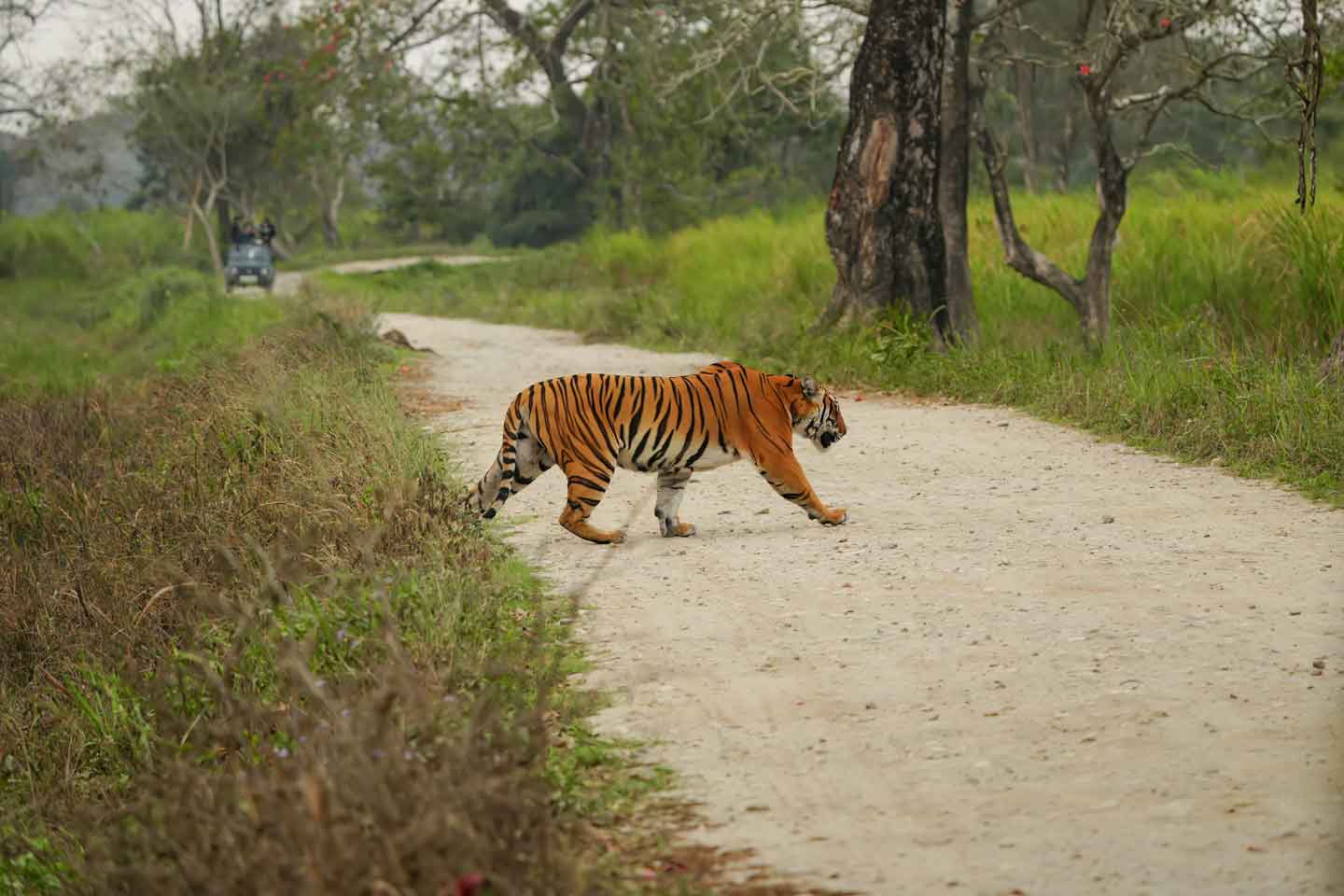
- Royal Bengal Tiger (Panthera tigris): Holding one of the highest breeding tiger densities on the planet at 11.8 to 15.2 tigers per 100 sq km, Kaziranga's lush alluvial prey base supports 148+ tigers that patrol tall grass corridors and riverine thickets.
- Asian Elephant (Elephas maximus): Home to over 1,940 wild elephants wandering in matriarchal herds between riverine wetlands and the forested ridges of Karbi Anglong.
- Wild Asiatic Water Buffalo (Bubalus arnee): Kaziranga preserves the world's largest remaining pure gene pool of wild water buffalo (2,900+ individuals, over 57% of the planet's total), notable for their formidable, sweeping horn spans exceeding two meters.
- Eastern Swamp Deer (Rucervus duvaucelii ranjitsinhi): An endemic subspecies (barasingha) numbering 868+ individuals, adapted specifically to swamp pastures with specialized splayed hooves that facilitate marsh locomotion.
In addition to the Big Five, the sanctuary harbors over 40,000 Indian hog deer (Axis porcinus), Sambar, barking deer, wild boar, Indian gaur, leopard cats, fishing cats, and the endangered Western Hoolock Gibbon (Hoolock hoolock)—India's only native ape species—found in the canopy of the southern hill tracts.
Kaziranga is also a BirdLife International Important Bird Area (IBA) supporting over 500 bird species. During winter, Sohola Beel and surrounding wetlands host thousands of migratory waterfowl traveling from Siberia and Central Asia, including Bar-headed Geese, Ferruginous Pochards, Greater and Lesser Adjutant Storks, Black-necked Storks, Pallas's Fish Eagles, Grey-headed Fish Eagles, Oriental Darters, Great Indian Hornbills, and the critically endangered Bengal Florican.
Safari Range Breakdown & Wildlife Zones
Tourism in Kaziranga is structured across four primary administrative ranges, each managed by the Assam Forest Department and offering distinct topography and wildlife sightings:
- Central Range (Kohora): Entered via the Mihimukh Gate (2 km from Kohora town). Characterized by open alluvial meadows, Sohola Beel, and ancient wetland marshes. It is the most balanced zone for viewing rhinos, wild buffaloes, swamp deer, and waterfowl. Mihimukh serves as the central hub for dawn elephant safaris and classic afternoon jeep safaris.
- Western Range (Bagori): Located 12 km west of Kohora along NH27. Renowned as the range with the highest density of Great One-Horned Rhinoceroses per square kilometer. Open dirt tracks wind through marsh pools, offering exceptionally close encounters with rhino mothers and calves, foraging elephant family herds, and massive buffaloes. It is also the most popular zone for early morning elephant safaris.
- Eastern Range (Agoratoli): Located 27 km east of Kohora. Defined by dense semi-evergreen canopy, oxbow lakes, and the vast open expanse of the Brahmaputra River. Agoratoli is an international birdwatcher's paradise, offering unparalleled views of raptors, pelicans, storks, and ducks, as well as excellent tiger-tracking potential along quiet river channels.
- Burapahar Range (Ghorakati): Located 40 km west of Kohora along the base of the Karbi Anglong Hills. Characterized by hilly, undulating forest trails beneath towering Ficus trees. It is the premier range for primate watching, including Western Hoolock Gibbons, Capped Langurs, and Malayan Giant Squirrels, with guided walking trails available near Rhonthali.
- Extended Riverine & Forest Zones: Northern Bank river safari circuits at Biswanath Ghat allow boat cruises along the Brahmaputra to spot endangered Ganges River Dolphins (Platanista gangetica), while the adjacent Panbari Reserve Forest offers exclusive rainforest birding.
Seasonal Rhythm & Best Time to Visit
Kaziranga National Park operates strictly from November 1 to April 30 / May 31 annually. The park is officially closed from May 1 to October 31 due to extensive Brahmaputra monsoon flooding.
- Peak Winter (November to February): Crisp, refreshing winter weather with daytime temperatures between 15°C and 25°C, dropping to 5°C – 10°C at dawn. Mornings are often enveloped in dramatic ground fog that burns off by 8:30 AM. Ideal for pleasant Jeep safaris, dawn elephant rides, migratory waterfowl birdwatching, and crystal-clear wildlife photography.
- Spring & Pre-Monsoon (March to April): Daytime temperatures range from 22°C to 35°C. During early March, forest rangers conduct controlled grass burning across the savannahs, reducing 8-foot elephant grass to short stubble. This provides the year's highest visibility for Royal Bengal Tiger and rhino sightings, as animals congregate around receding water bodies.
Transit Logistics & Gateway Access
- By Air: The primary national and international gateway is Guwahati's Lokpriya Gopinath Bordoloi International Airport (GAU), situated 217 km (4 to 4.5 hours) to the west via smooth 4-lane National Highway 27. Alternatively, Jorhat Airport (Rowriah, JRH) is located 97 km (2 hours) to the east with daily regional domestic connections. Tezpur Airport (TEZ) is 80 km away via the Kaliabhomora Brahmaputra bridge.
- By Rail: Jakhalabandha Railway Station (JKB) is the closest local rail stop (40 km away). Furkating Junction (FKG) (75 km / 2 hours) serves overnight express trains from Guwahati, while Guwahati Railway Station (GHY) (200 km / 4 hours) provides direct superfast connectivity to Delhi, Kolkata, Mumbai, and Bengaluru.
- By Road: Kaziranga sits directly along National Highway 27 (NH27), a well-engineered 4-lane highway traversing scenic Assamese countryside and emerald tea estates.
Local Food Culture & Assamese Culinary Traditions
Assamese food culture is celebrated for its fresh, wholesome flavors, reliant on aromatic indigenous herbs, fermented ingredients, and fresh river catch without heavy commercial spices or artificial coloring:
- Masor Tenga: The quintessential Assamese dish—a light, refreshing sour fish curry cooked with fresh river fish (such as Rohu or Chital) and soured with ripe tomatoes, kazi nemu (Assam lemon), or outenga (elephant apple).
- Khar: A traditional alkaline delicacy made from sun-dried, burned banana peels (kolakhar) cooked with raw papaya, pulses, and mustard oil, customarily served as the first course of an authentic Assamese meal.
- Kumura Diya Hahor Mangxo: Tender duck meat slow-cooked with ash gourd and whole crushed spices, a classic winter delicacy across rural Upper Assam.
- Joha Rice: Indigenous, small-grain aromatic rice known for its delicate fragrance and sweet aroma, served alongside fresh xaak (green leafy vegetables) and pitika (mashed potatoes, fish, or eggplant seasoned with raw mustard oil, green chillies, and chopped onions).
- Assam Orthodox Tea & Pitha: No visit to Kaziranga is complete without savoring fresh, brisk Assam orthodox black tea brewed from leaves harvested at adjacent estates such as Hathikuli Organic Tea Estate, accompanied by traditional rice cakes (til pitha and ghila pitha).
Regional Heritage & Cultural Attractions
- Kaziranga National Orchid and Biodiversity Park: Located 2 km from Kohora, this 6-acre conservation center houses over 500 wild indigenous orchid species, an ethnic rice museum with 200+ heritage seeds, a medicinal herbal garden, a traditional handloom weaving shed, and daily live performances of energetic Bihu folk dance.
- Hathikuli Organic Tea Estate: An expansive, 100% certified organic tea plantation bordering the park boundary along NH27, renowned for sustainable wildlife-friendly agricultural practices and organic black and green tea processing.
- Kakochang Waterfalls: A scenic 30-meter jungle waterfall located 13 km from Bokakhat, accessed via a picturesque 20-minute hiking trail winding through rubber trees and coffee plantations.
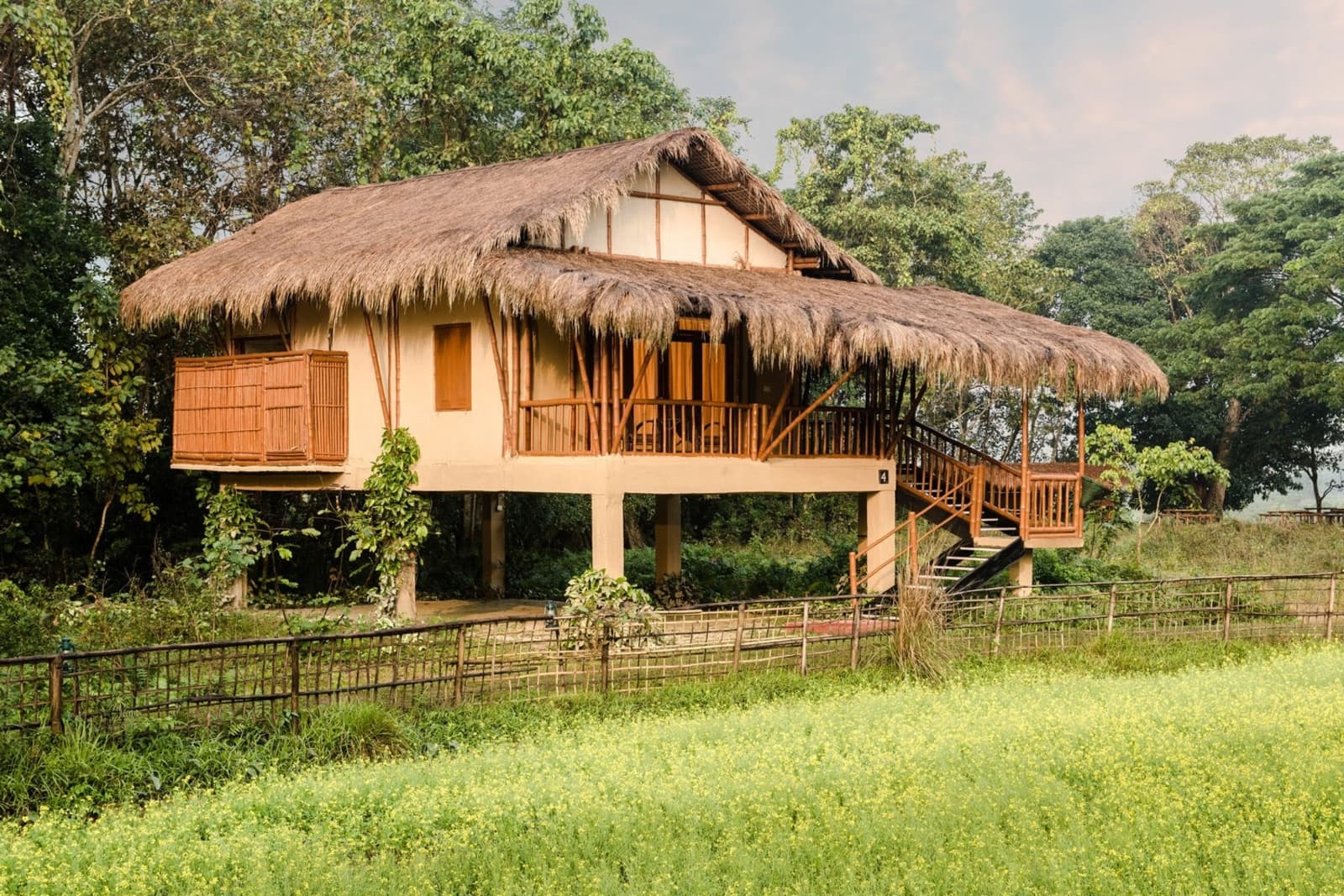
- Mishing & Karbi Tribal Hamlets: Rural stilt-house (chang ghar) villages where travelers can observe traditional silk weaving (Muga and Eri silk) and authentic agrarian lifestyles.
Practical Travel Guide (The Honest Guide)
- Highway Speed Cameras & Wildlife Corridors: Automated sensor radar speed cameras monitor NH27 across designated animal corridors with a strict 40 km/h speed limit. Speed violations incur heavy computerized fines to protect migrating wildlife crossing between the floodplains and the Karbi Anglong Hills.
- Forest Department Entry Passes & Gate Permits: Assam does NOT require an Inner Line Permit (ILP) for Indian or foreign nationals. However, official Forest Department entry tickets, vehicle tolls, guide fees, and camera passes must be secured at range counters (Kohora, Bagori, Agoratoli, or Burapahar) prior to each morning (entry 7:30 AM) and afternoon (entry 1:30 PM) safari shift.
- Safari Vehicle Mandates: Personal and rental private cars are strictly forbidden inside core park tracks. All safaris must be conducted in authorized open-top 4x4 Gypsy vehicles accompanied by an assigned armed forest guard or guide.
- Cash & Mobile Network Connectivity: High-speed 4G/5G mobile data (Airtel and Jio) is robust in Kohora, Bagori, and resort corridors, but cellular signals drop completely inside deep core forest tracks. While ATM kiosks operate in Kohora, carrying physical cash is essential for camera fees, guide tips, and local village handicrafts.
- Safari Strategy: Wildlife sightings vary daily by weather and water levels. Travelers are strongly advised to book at least 3 to 4 safaris across two or more ranges (such as combining Bagori for close rhino viewing with Agoratoli or Kohora for landscapes and birdlife) to maximize sighting opportunities.
Kaziranga is home to two-thirds of the world's one-horned rhinoceros population.
TRAVEL PLANNING
Plan Your Visit
Essential guides to prepare for your trip
Book Jeep Safari
Calculate rates & book open-top jeep safaris online
Book Elephant Safari
Reserve early morning elephant safari seats online
Safari Guide
Jeep & elephant safari prices, timings, zones, and booking process
Itineraries & Trips
Curated 3-day, 5-day & 7-day trip routes
Places to Visit
Top waterfalls, viewpoints & landmarks
Best Time to Visit
When to go for the best experience
Book Kaziranga Safaris Online
Daily vehicle quotas apply per zone. Reserve open 4x4 Jeep and dawn Elephant safari permits in advance.
Need a Custom Plan?
As Kaziranga locals, we'll design your personalized itinerary right from our home here.
Talk to an ExpertTOP ATTRACTIONS
Places to Visit in Kaziranga
Must-see attractions and hidden gems across Kaziranga


- Kaziranga National Orchid and Biodiversity Park: Explore Northeast India's largest orchidarium, 500+ wild species, rice seed museum, live Bihu dances, and Assamese heritage handlooms.
- Bhomoraguri Boat Safari: **Bhomoraguri Boat Safari** is an ecotourism activity located at the Bhomoraguri Ecotourism Zone in Tezpur, Sonitpur District, Assam. Managed by the *
- Elephant Safari in Western Range: Dawn patrol on elephant-back to track rhinos closely in Bagori.
- Elephant Safari in Central Range: Track wild rhinos silently at sunrise from the Mihimukh riding tower.
- Dhanbari Ghat Boat Safari: **Dhanbari Ghat Boat Safari** is a riverine wildlife activity located at Dhanbari Ghat, near the Agoratoli Range of Kaziranga National Park, Golaghat
- Hollongapar Gibbon Sanctuary: India’s Primate Forest Island
- Deopahar Archaeological Site: The Stone Temple Ruins of Numaligarh
- Kakochang Waterfall: A stunning multi-tiered waterfall cascading down the Karbi Anglong foothills near Bokakhat
- Elephant Safari in Burapahar Range: An offbeat forest canopy adventure tracking primates and wild elephant herds in Ghorakati.
- Traditional Dance & Cultural Program in Kaziranga: Explore the beauty of Traditional Dance & Cultural Program in Kaziranga in Kaziranga.
- Roop's Kitchen: Explore the beauty of Roop's Kitchen in Kaziranga.
- Jeep Safari in Central Range, Kaziranga: Ride through the core marshy floodplains of the Kohora range.
How Many Days in Kaziranga?
Plan your own route — or let us handle everything
Things to Do in Kaziranga
Curated experiences and activities across Kaziranga by local experts

Where to Stay in Kaziranga
Verified stays in Kaziranga with local character




Getting Around
Safe, reliable transfers and car hire in Kaziranga
Practical Travel Realities & Local Tips
Terrain, ground rules, and essential preparation for Kaziranga
Kaziranga is a very easy and accessible destination. It requires minimal physical exertion as all wildlife viewing is done from vehicles or elephant back.
- Jeep Safaris: Bumpy, muddy tracks inside the forest in open-top jeeps. Can be dusty or muddy depending on the month. Suitable for all ages. Not recommended for severe back conditions.
- Elephant Safaris: Early morning rides lasting 1 hour. Mounting requires climbing a small platform. Can be uncomfortable for people with back or knee issues. Not recommended for pregnant women.
- Accessibility: The park trails are uneven earth and gravel. Wheelchair access is extremely limited inside the park. Resorts and lodges are generally accessible.
Local Culinary Traditions & Food
Authentic indigenous gastronomy, tribal flavours, and culinary culture in Kaziranga
Assamese cuisine is mild, largely non-vegetarian, and rice-based. Resorts in Kaziranga serve both local and North Indian cuisines. Here is what to try:
- Masor Tenga: A defining Assamese dish—a light, sour fish curry typically flavored with tomatoes or outenga (elephant apple).
- Duck Meat Curry: Often cooked with ash gourd, a delicacy in Assam, especially during winter.
- Pitha: Sweet or savory rice cakes usually made during Bihu. Try til pitha (sesame) and ghila pitha (fried rice cakes).
- Assam Tea: You cannot leave Kaziranga without drinking strong, authentic Assam black tea. Visit a tea estate for a tasting experience.
- Khar: A unique Assamese dish made with raw papaya, pulses, and alkali — traditionally the first item served in an Assamese thali.
- Where to eat: Most resorts serve buffet meals. Kohora town has local Assamese restaurants. For fine dining, try Borgos Resort or Diphlu River Lodge.
Combine Kaziranga With
Extend your trip with nearby destinations
Travel Guides
Expert guides for Kaziranga
Reviews
"Nezo Tours organized our fantastic Kaziranga trip in 2024. The team was attentive and flexible, accommodating last-minute changes to suit our needs."
Yamini Peter
Mumbai, Maharashtra
"The jeep safari at Kaziranga was incredible. Saw rhinos, elephants, and even a tiger. Nezo handled everything perfectly from pickup to drop."
Rajesh Khanna
Kolkata, West Bengal
"An unforgettable experience at Kaziranga. The elephant safari at dawn was magical. Our guide was knowledgeable and passionate about wildlife."
Sarah Williams
London, UK
PLAN YOUR TRIP
FAQs
Can't find the answer you're looking for? Our expert travel team is always on hand to help you plan the perfect Kaziranga experience.
Ready to Explore Kaziranga?
Let our local experts help you plan the perfect trip. Get personalized recommendations and instant quotes.