
Khonoma (Khwüno-ra)
Updated 2026Asia's First Green Village & Historic Angami Fortress
| Category | Detail |
|---|---|
| Altitude / Elevation | 1,600 m (5,249 ft) |
| Atm Availability | No ATMs (Nearest ATMs in Kohima, 20 km) |
| Best Time to Visit | October to April |
| Community Fee | ₹50 (Indian) / ₹100 (Foreigner) village entry fee |
| Coordinates | 25.6423° N, 94.0201° E |
| Drive From Dimapur | 94 km (3–3.5 hours via NH29 & Kohima) |
| Drive From Kohima | 20 km (45–60 minutes via Western Angami road) |
| Permit Requirement | Yes (Inner Line Permit for Nagaland) |
| Mobile Network | Intermittent 4G on Jio/Airtel in village center; weak/no signal in valleys & sanctuary |
| Rainfall | 2,000–2,500 mm annually (Monsoon: Jun–Sep) |
| Temperature Range | 4°C to 24°C |
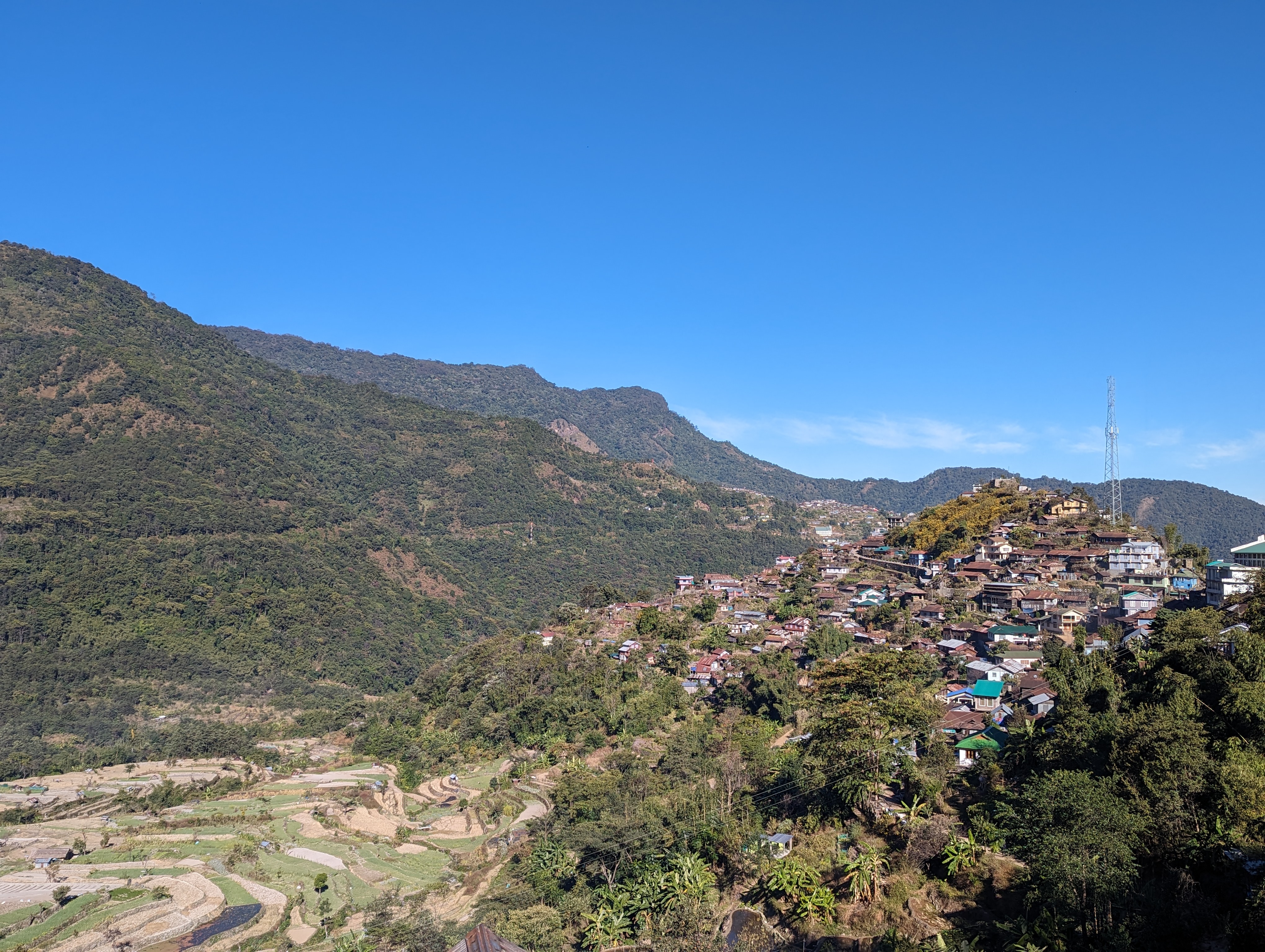
Khonoma (Khwüno-ra) is a 700-year-old Angami Naga heritage and eco-tourism village in Kohima District, Nagaland, situated at an elevation of 1,600 meters (5,249 feet) above sea level. Located 20 km west of Kohima, it is globally celebrated as Asia's first green village, renowned for its 1879 Anglo-Naga war battlements, self-sustaining alder tree agroforestry, and the 20 sq km community wildlife sanctuary.
The sharp highland air smells of burning oak firewood, damp alder foliage, and roasted mountain chillies drifting from traditional wooden clan homes. Down the mist-covered ravine, the rhythmic tapping of woodworkers shaping alder timber mingles with the flute-like morning whistle of Blyth's tragopans echoing across centuries-old stone-walled paddy terraces.
Inner Line Permit (ILP) is mandatory for all domestic Indian travelers entering Nagaland (apply online at ilp.nagaland.gov.in). Foreign travelers require Foreigner Registration (FRO) in Kohima or Dimapur within 24 hours of arrival. A nominal community eco-development fee (₹50 Indian / ₹100 Foreigner) is collected at the Khonoma village gate.
Geography, Topography & Highland Terraces
Khonoma sits poised along a commanding high mountain spur in the Western Angami highlands of Kohima District, Nagaland, perched at an altitude of 1,600 meters (5,249 feet) above sea level. Spanning a diverse geological elevation profile that extends from 1,400 meters in the stream-carved valley floors to over 1,850 meters along upper ridge viewpoints, the settlement occupies a strategic geographical location overlooking the fertile Dzüko and Khonoma river valleys. The topography is characterized by precipitous mountain spurs dramatically carved into vast amphitheaters of stepped agricultural terraces (Pani Kheti), sculpted by Angami farming clans over more than seven centuries. The village settlement itself is organized vertically along the natural contours of the mountain ridge, divided into three ancestral clan sectors or khels—Merhüma, Semoma, and Pitroma—each reinforced with interconnected stone ramparts, paved walkways, terraced lookout platforms, and fortified defensive walls. To the southwest and south, the terrain rises steeply into the dense temperate rainforests of the Barail Mountain Range, serving as a vital biological corridor connecting the Western Angami highlands with the alpine bamboo meadows of Dzukou Valley and the soaring peak of Mount Japfu (3,048 meters).
History, Angami Clan Warfare & The 1879 Siege of Khonoma
Khonoma holds an indelible, storied place in the military history of Northeast India as an impregnable citadel of the Angami Naga people. Founded over 700 years ago, the village earned renown across the Naga Hills for the unmatched military prowess, tactical discipline, and fiercely independent spirit of its warrior clans. During the 19th century, as the British East India Company and subsequently the British Crown expanded colonial dominion into Upper Assam to protect expanding commercial tea estates, British survey expeditions and administrative officers encountered formidable armed resistance from Khonoma's warriors. Between 1835 and 1879, the British military launched multiple punitive expeditions into the rugged Angami hills, culminating in the historic Battle of Khonoma in October 1879.
The conflict reached a boiling point when the British Political Officer of the Naga Hills, G.H. Damant, marched on Khonoma with an armed escort and was killed at the village entrance gates by Angami defenders. In response, a massive British military force under Brigadier-General Nation, equipped with mountain artillery and heavy ordnance, laid siege to Khonoma. Entrenched behind the thick stone bastions, loopholed ramparts, and subterranean shelters of Semoma Fort, Khonoma warriors armed with hand-forged iron spears, muzzle-loading flintlock muskets, and daos (Naga swords) repelled repeated assaults for months. The siege concluded with a formal peace accord in 1880, establishing a lasting mutual respect and cementing Khonoma’s reputation as an unconquered warrior bastion. Today, travelers can walk along the preserved stone battlements of Semoma Fort and examine ancestral wooden clan gates that still bear the visible bullet scars and powder indentations of the 1879 siege.
The 1998 Conservation Revolution & The KNCTS Wildlife Sanctuary
In the late 20th century, Khonoma spearheaded one of the most remarkable conservation turnarounds in modern Asian history, earning global recognition as Asia’s First Green Village. For generations, hunting was deeply entwined with traditional Naga warrior culture, tribal feasts, and personal status. However, by the early 1990s, village elders and local naturalists noted an alarming depletion of forest fauna and regional bird populations—most critically Nagaland’s magnificent state bird, the vulnerable Blyth’s Tragopan (Tragopan blythii). During a single post-harvest community festival in 1993, over 300 tragopans were reportedly hunted in the surrounding forests. Alarmed by this ecological crisis, forward-thinking village leaders, including conservationist Tsilie Sakhrie and the Khonoma Village Council, initiated intensive community consultations with clan heads, youth leaders, and women's associations.
In December 1998, the Khonoma Village Council took the historic, unanimous resolution to declare 20 sq km (roughly 2,000 hectares) of virgin community forest as the Khonoma Nature Conservation and Tragopan Sanctuary (KNCTS). The council enacted a total, self-imposed ban on hunting, commercial tree felling, and forest burning across their entire ancestral territory. Enforced by youth community forest guards (VDB patrols) and substantial monetary fines, the sanctuary transformed into a thriving haven for biodiversity. Recognized by the Wildlife Institute of India (WII) and international conservation agencies, the sanctuary is now home to over 140 bird species—including the Blyth’s Tragopan, Kalij Pheasant, Mountain Bamboo Partridge, Grey-bellied Tesia, and Great Barbet—as well as leopard cats, Asian black bears, barking deer (Muntiacus muntjak), and endemic orchids.
Ancient Alder Agroforestry & Sustainable Mountain Farming
Khonoma’s agrarian landscape represents one of the world's most sophisticated indigenous systems of sustainable bio-engineering and soil stewardship. For more than 300 years, Angami farmers have integrated the native Himalayan Alder (Alnus nepalensis) tree into their shifting (jhum) and terraced wet-paddy agriculture. Unlike conventional chemical farming that rapidly depletes topsoil, Khonoma's agroforestry relies on the biological symbiosis between the alder tree and nitrogen-fixing root microorganisms (Frankia actinorhizae), which continuously regenerate mountain soil fertility naturally.
Farmers practice a precise cyclical pruning technique known as pollarding: when an alder tree reaches maturity (approx. 2 feet trunk diameter), the main trunk is decapitated at five to six feet above the ground, and subsequent vertical shoots are pollarded on a strict 4 to 6-year rotation. The pruned branches provide sustainable firewood, light timber for building, and green foliage that serves as nutrient-rich organic mulch for companion crops like maize, wild mountain beans, job's tears, garlic, and chillies. Furthermore, the alder's extensive root systems anchor the steep hill slopes, preventing catastrophic soil erosion during heavy monsoon deluges. On the valley floor, spring-fed mountain aqueducts irrigate vast stepped terraces producing heirloom sticky red rice (Ruodi), allowing continuous organic cropping for centuries without soil exhaustion.
Village Architecture, Clan Khels & Morung Heritage
A walking tour through Khonoma is an immersive masterclass in traditional Angami spatial engineering, timber craftsmanship, and clan sociology. The village is organized into three distinct khels (clan sectors)—Merhüma, Semoma, and Pitroma—each functioning as an autonomous socio-political unit with its own clan council, stone assembly squares, and defensive perimeter. Each khel is entered through an ancestral carved wooden clan gate (Kharu), hand-hewn from massive single slabs of local hardwood and sculpted with symbolic warrior motifs: crossed spears, hornbill feathers, Mithun horn emblems denoting prosperity, and the human head motif symbolizing ancestral courage.
At the spiritual and social core of each sector stands the Morung (Kichuki), the traditional youth dormitory and clan institution. Historically, the morung served as a military command center, educational academy where oral history and folklore were transmitted, and a craft workshop where young warriors learned basket weaving, wood carving, and weapons crafting. Khonoma's residential dwellings feature massive dry-stone foundations, hand-split wooden timbers, and pitched metal roofs hung with bundles of drying maize and Naga chillies. Scattered throughout the stone pathways are ancient megalithic memorial stones (Dahu platforms) and warrior monoliths erected during ancient Feasts of Merit, where affluent families shared their wealth with the entire community.
Local Food Culture & Traditional Angami Cuisine
Culinary traditions in Khonoma reflect an intimate, organic bond between the mountain ecosystem, family terrace plots, and the traditional woodfire hearth. In the absence of commercial restaurants, every meal in Khonoma is prepared fresh in homestay kitchens around the indoor fire pit (mezhü), which serves as the social heart of every Angami household. The quintessential everyday specialty is Galho, a deeply nourishing, fragrant rice porridge simmered with indigenous unpolished red rice, tender seasonal wild greens, crushed mountain ginger, and cured wood-smoked pork or seasoned pork lard. Hearty vegetarian versions of Galho prepared with fresh bamboo shoots and hill herbs are equally popular.
Another revered centerpiece is wood-smoked pork slow-simmered with pungent Axone (fermented soybean paste, also known as akhuni) and fiery Naga King Chillies (Bhut Jolokia). Clear, invigorating broths prepared with Bastenga (naturally fermented bamboo shoots), local mountain stream trout, country chicken, or wild fiddlehead ferns provide a distinctive tart and earthy flavor profile. Meals are complemented by fiery side chutneys made from fire-roasted Naga Tree Tomatoes (tamarillos) crushed with roasted garlic, king chillies, and mountain coriander. During festivals and community gatherings, host families offer sips of Zutho and Thutshe, traditional home-brewed fermented rice beverages with a subtly tart, creamy, and refreshing character. Vegetarian and vegan travelers are warmly welcomed, with homestay hosts crafting abundant spreads of steamed squash, mountain yam, stinging nettle broth (dzükhu), and organic hill lentils.
How to Reach & Mountain Transit Logistics
Khonoma is located 20 km west of Kohima and 94 km from Dimapur. The primary long-distance transit hub is Dimapur Airport (DMU) and Dimapur Railway Station, which offers scheduled flights from Kolkata and Guwahati, and direct broad-gauge rail links to New Delhi, Kolkata, and Guwahati via premier trains including the Dibrugarh Rajdhani Express, Kamrup Express, and Jan Shatabdi Express. From Dimapur, travelers proceed along the four-lane NH29 highway corridor through the scenic Chumukedima gorge to Kohima (74 km, 2.5 hours). From Kohima, the route branches west along the paved Western Angami mountain road, winding past Science College and Jotsoma to Khonoma (20 km, 45–60 minutes).
Private taxis (Innova, Bolero, Scorpio) can be chartered from Dimapur directly to Khonoma for ₹3,500–₹4,500, or hired from Kohima for ₹1,200–₹1,800 one-way (₹2,200–₹2,800 round trip with waiting time). Shared passenger Tata Sumos depart from the Kohima BOC Sumo stand to Khonoma on weekdays between 06:30 AM and 01:00 PM (₹100–₹150 per seat). It is critical to note that public transport, taxis, and commercial services do not operate on Sundays across Nagaland due to Sabbath church services; visitors traveling on a Sunday must pre-arrange private transport in advance.
Practical Travel Guide (The Honest Guide)
Traveling to Khonoma requires realistic preparation for an authentic, high-altitude village experience. First, the entire internal village is strictly pedestrianized: all passenger vehicles must park at the entrance terrace outside the main gate, requiring visitors to navigate hundreds of steep hand-hewn stone steps and cobblestone pathways on foot (lightweight backpacks are strongly advised over rolling suitcases). Second, there are absolutely NO ATMs in Khonoma; while some homestays accept UPI digital payments when 4G mobile data is active, network coverage can be intermittent, making it essential to carry ₹5,000 to ₹10,000 in physical cash from Kohima.
Third, Inner Line Permits (ILP) are legally mandatory for all domestic Indian citizens entering Nagaland (apply online at ilp.nagaland.gov.in), while foreign travelers must complete mandatory registration with the Foreigners Registration Officer (FRO) in Kohima or Dimapur within 24 hours of arrival. Fourth, the village collects a nominal community eco-development fee (₹50 Indian / ₹100 Foreigner) at the entrance gate kiosk to finance trail maintenance and forest sanctuary patrols. Finally, Khonoma observes Sunday as a sacred day of church worship and family rest—shops and restaurants remain closed, offering visitors a peaceful setting for quiet nature walks and respectful cultural observation.
Khonoma is part of the breathtaking Northeast India region, known for its pristine natural beauty, rich tribal culture, and unique biodiversity.
TRAVEL PLANNING
Plan Your Visit
Essential guides to prepare for your trip
Itineraries & Trips
Curated 3-day, 5-day & 7-day trip routes
Places to Visit
Top waterfalls, viewpoints & landmarks
Best Time to Visit
When to go for the best experience
How to Reach
Flights, trains, taxis and road options
Where to Stay
Homestays, eco-lodges & resorts
Permits & Entry
Required documents and ILP pass guidance
Khonoma Tour Packages
Ready-to-book Khonoma tours

Need a Custom Plan?
As Northeast India locals, we work directly with our trusted community drivers and homestay hosts.
Talk to an ExpertTOP ATTRACTIONS
Places to Visit in Khonoma
Must-see attractions and hidden gems across Khonoma

- Khonoma Green Village: Asia's First Green Village & Historic Angami Fortress
How Many Days in Khonoma?
Plan your own route — or let us handle everything
Things to Do in Khonoma
Curated experiences and activities across Khonoma by local experts
Where to Stay in Khonoma
Verified stays in Khonoma with local character


Getting Around
Safe, reliable transfers and car hire in Khonoma
Practical Travel Realities & Local Tips
Terrain, ground rules, and essential preparation for Khonoma
Khonoma is rated as an Easy to Moderate cultural and eco-tourism destination. While no technical climbing is involved, the village's steep mountain topography requires basic mobility and stamina.
Village Exploration on Foot (Moderate)
The interior of Khonoma is completely pedestrianized. Visitors must navigate hundreds of hand-hewn stone staircases, cobblestone alleys, and terraced paths connecting the three historic *khels* (Merhüma, Semoma, and Pitroma). Ascending from the valley entrance to Semoma Fort involves climbing roughly 150 to 200 vertical meters of stone stairs. Comfortable walking shoes or trail runners with excellent grip are essential.
Sanctuary & Forest Trekking (Moderate to Strenuous)
Hikes into the 20 sq km Khonoma Nature Conservation and Tragopan Sanctuary (KNCTS) or along the 18 km forest bridle trail to Dzuleke follow dirt paths with uneven roots, muddy inclines, and elevation changes between 1,400 m and 2,200 m. A walking stick and certified local guide are strongly recommended.
Altitude & Health Considerations
Khonoma sits at an elevation of 1,600 meters (5,249 feet). The altitude is gentle and does not trigger Acute Mountain Sickness (AMS). However, travelers with knee problems or limited mobility should take the stone staircases at a relaxed pace with frequent rest stops.
Local Culinary Traditions & Food
Authentic indigenous gastronomy, tribal flavours, and culinary culture in Khonoma
Dining in Khonoma is an authentic, farm-to-table cultural experience. With no commercial restaurants or fast-food outlets, all meals are prepared fresh in homestay kitchens over indoor wood-burning hearths (*mezhü*), utilizing organic ingredients harvested directly from family terrace plots and surrounding forests.
Signature Angami Dishes & Specialties
- Galho: The quintessential Angami comfort food—a hearty, fragrant rice porridge simmered with local red rice, wild mountain greens, crushed ginger, and cured smoked pork or seasoned lard. Wholesome vegetarian versions with bamboo shoots and seasonal beans are widely served.
- Wood-Smoked Pork with Axone: Slices of dry-smoked pork braised with pungent fermented soybean paste (*axone* / *akhuni*), dried Naga King Chillies (*Bhut Jolokia*), and aromatic mountain herbs.
- Bastenga (Fermented Bamboo Shoot) Stew: Country chicken, fresh river trout, or local pork simmered in a tangy broth made from fermented bamboo shoots, producing a sharp, earthy flavor profile.
- Naga Tree Tomato (Tamarillo) Chutney: Fire-roasted tree tomatoes mashed with roasted king chillies, garlic, and fresh coriander—a fiery condiment that accompanies every traditional meal.
- Organic Mountain Greens & Tubers: Steamed stinging nettles (*dzükhu*), wild yam, fiddlehead ferns, pumpkin leaves, and mustard greens boiled with salt and green chillies.
- Unpolished Terrace Red Rice: Highly nutritious, nutty heirloom rice harvested from Khonoma's centuries-old gravity-irrigated stone terraces.
- Zutho & Thutshe: Traditional Angami home-brewed fermented rice beverages with a mildly tart, creamy, and refreshing finish, offered during festivals and community gatherings.
Vegetarian Dining in Khonoma
While traditional Naga cuisine features pork and poultry, Khonoma homestays excel at accommodating vegetarian and vegan guests with prior notice. Hosts prepare delicious platters of organic vegetables, wild forest mushrooms, squash, lentils, and fresh herb salads.
Combine Khonoma With
Extend your trip with nearby destinations
Travel Guides
Expert guides for Khonoma
Reviews
"Nezo Tours organized our fantastic trip. The team was attentive and flexible, accommodating last-minute changes to suit our needs."
Yamini Peter
Mumbai, Maharashtra
"We got the best service than expected. The guide was very friendly and very very helpful, throughout our journey he guided us."
Ammiel Shabong
Shillong, Meghalaya
"Service was excellent. Prices were the best compared to those offered by others. All in all a satisfying experience. Definitely recommended."
Pradeep Agarwal
Delhi, India
PLAN YOUR TRIP
FAQs
Can't find the answer you're looking for? Our expert travel team is always on hand to help you plan the perfect Khonoma experience.
Ready to Explore Khonoma?
Let our local experts help you plan the perfect trip. Get personalized recommendations and instant quotes.